Brain fog is one of those terms that feels instantly familiar and strangely slippery at the same time.
Most people know what it points to. But once people start describing it, they often mean very different things: mental slowness, poor recall, word-finding trouble, dissociation, fatigue, pressure behind the eyes, executive dysfunction, or the feeling that the brain never fully “switches on.”
That ambiguity is what made the Reddit question interesting to me:
What keeps showing up when people with brain fog compare notes in the wild?
So I built a Reddit collection pipeline, pulled the last five years of brainfog and brain fog discussions, added the full r/BrainFog subreddit over the same period, deduplicated the threads, and ran a structured analysis across the full dataset.
The final working set included:
2,073threads151,767comments466subreddits- coverage from
2021-03-14to2026-03-07
The goal was not to prove what medically works. Reddit cannot do that. The goal was something narrower, and in its own way more useful: to map the structure of the conversation.
- what gets mentioned most
- what gets described positively
- what seems polarizing
- what low-visibility ideas look better than expected
- what patterns point toward recurring subtypes
Methodologically, the rankings below are based on thread-level evidence rather than raw comment volume. Positive mentions add to a score, negative mentions subtract from it, and mixed mentions count as partial support. That keeps one giant thread from distorting the rest of the dataset.
Important caveat: this is community self-report, not clinical evidence. Read it as a map of recurring hypotheses, experiences, and intervention patterns, not as a treatment guide.
If you want to inspect the hero chart directly, open the full-resolution overview here.
The short version
Once you zoom out, the conversation becomes much more structured than it first appears.
It is not just a cloud of random desperation posts. And it is not dominated mainly by fringe biohacking. Across five years and more than 150,000 comments, the same themes keep resurfacing: sleep, nutrient status, movement, hydration, stress regulation, diet, stimulants, antihistamines, hormones, breathing, and pacing.
A second pattern is just as striking: the strongest signals are often less glamorous than people expect. Sleep hygiene, therapy, hydration, walking, magnesium, B12, iron, and basic nutrition changes show up over and over again. The center of gravity is much closer to regulation and correction than to miracle hacks.
Then there is a third layer: some lower-visibility ideas appear stronger than their level of attention would suggest. Antihistamines, CPAP / BiPAP, L-theanine, hormone-related interventions, and a handful of quieter strategies stand out more than their visibility would predict.
This does not make them proven. It makes them interesting.
1. What gets mentioned most?
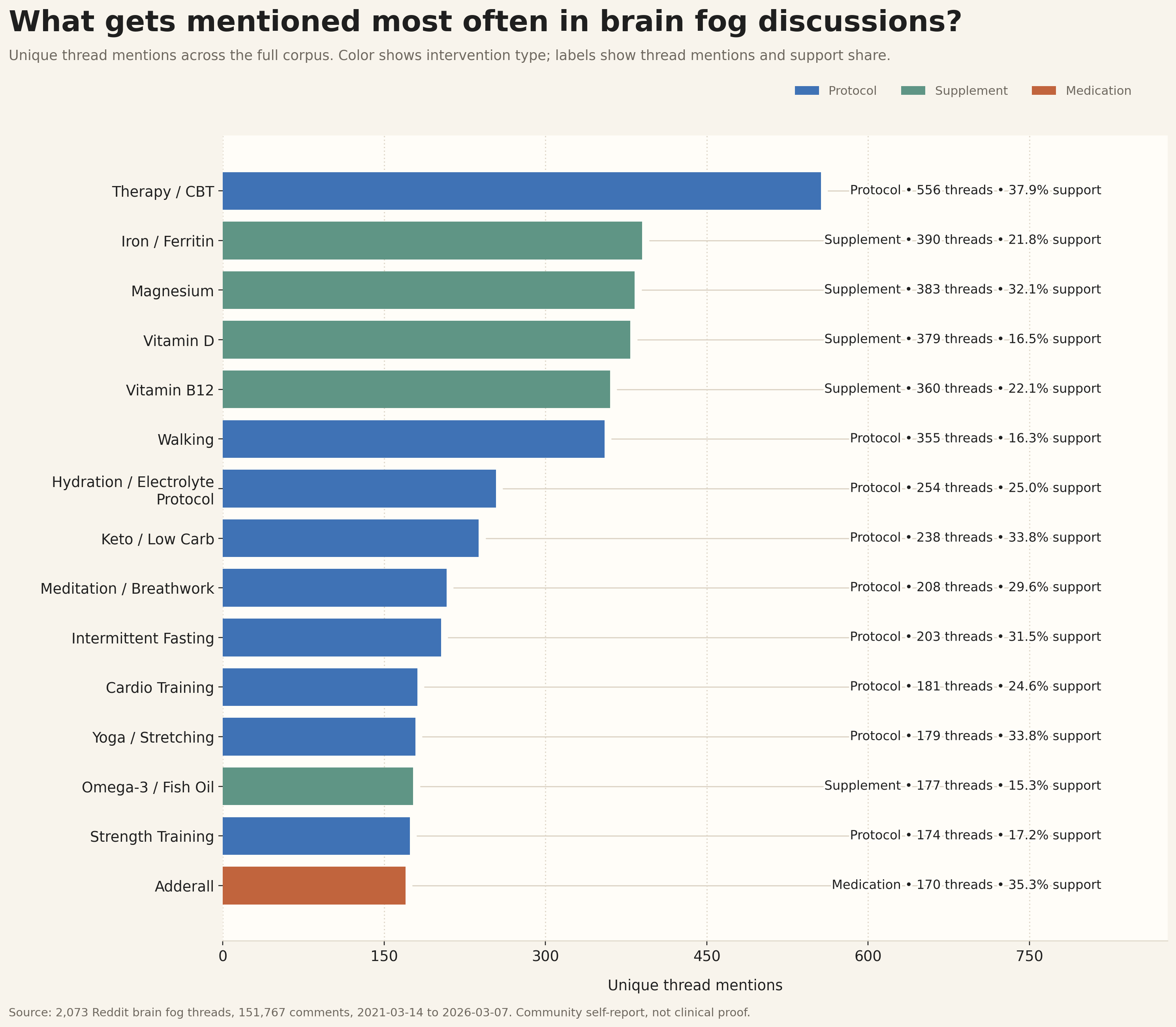
This is the raw attention map. It tells us which interventions dominate the conversation, regardless of whether people describe them positively or negatively.
The headline is simple: protocols and fundamentals dominate. Therapy / CBT, walking, hydration / electrolytes, keto / low carb, meditation / breathwork, and intermittent fasting all appear near the top. On the supplement side, iron / ferritin, magnesium, vitamin D, and vitamin B12 are unusually persistent. Adderall is the most visible medication in the broad intervention mix.
That matters because it suggests that the Reddit brain fog discourse is not mostly about exotic biohacking. It is heavily anchored in sleep, nutrition, deficiency correction, movement, and self-regulation.
2. Which interventions come out strongest overall?
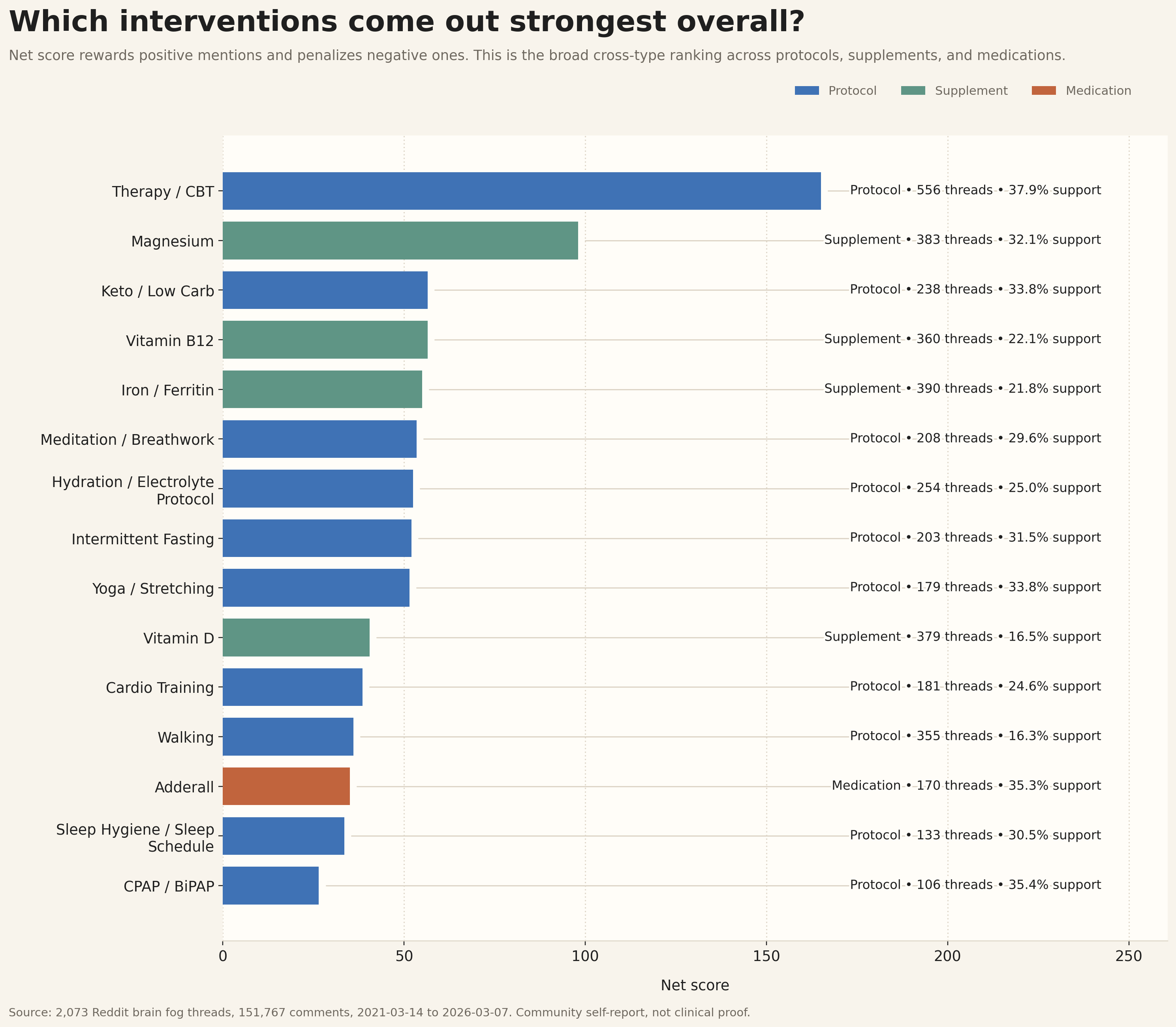
This chart moves from mere visibility to a more useful summary: a net score that rewards positive reports and penalizes negative ones.
The most important result is that Therapy / CBT sits clearly on top of the overall ranking. Magnesium is the strongest supplement-level signal. Keto / Low Carb, Vitamin B12, Iron / Ferritin, Meditation / Breathwork, Hydration / Electrolyte Protocol, Intermittent Fasting, and Yoga / Stretching all remain strong.
This is a good place to notice something subtle: the best overall signals are not all of the same type. Some are broad lifestyle protocols, some are probable root-cause corrections, and some are symptom-management tools. That is one reason brain fog is so difficult to compress into a single recommendation.
3. Which interventions look promising, and which look divisive?
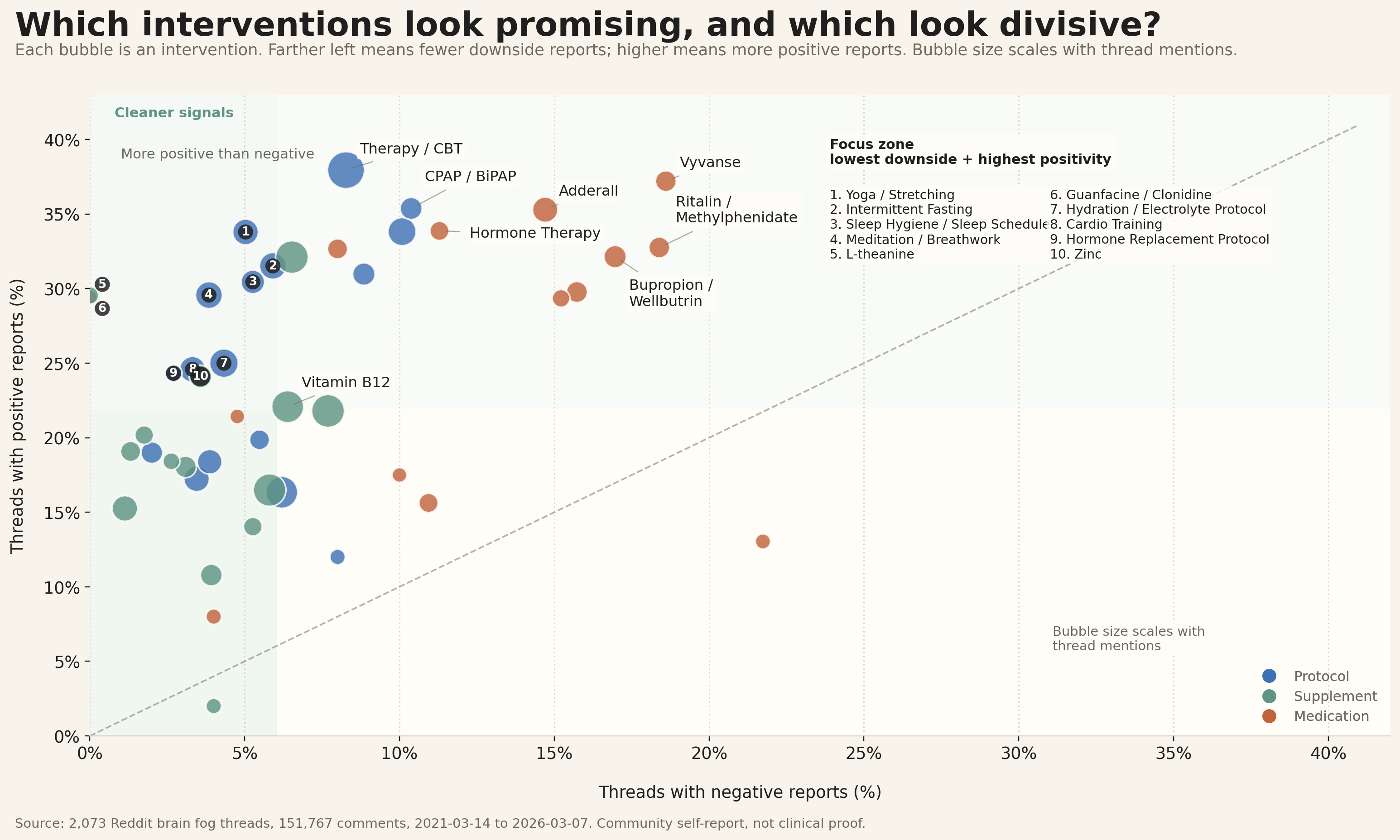
This chart is the single best overview in the entire post.
The x-axis shows the share of mentioning threads that describe an intervention negatively. The y-axis shows the share of mentioning threads that describe it positively. So the most attractive region is the upper left: more positive reports, fewer negative ones.
That focus zone is where several clean signals cluster:
Yoga / StretchingIntermittent FastingSleep Hygiene / Sleep ScheduleMeditation / BreathworkL-theanineGuanfacine / ClonidineHydration / Electrolyte ProtocolCardio TrainingHormone Replacement ProtocolZinc
The chart also shows why some medications need a more careful reading. Vyvanse, Ritalin / Methylphenidate, Adderall, and Bupropion / Wellbutrin can sit fairly high on positive reports while also drifting rightward into a more divisive zone. In plain English: they can help, but they also generate more downside reports and more disagreement.
Some interventions look broadly clean. Others look powerful but unstable.
4. Which supplements lead the pack?
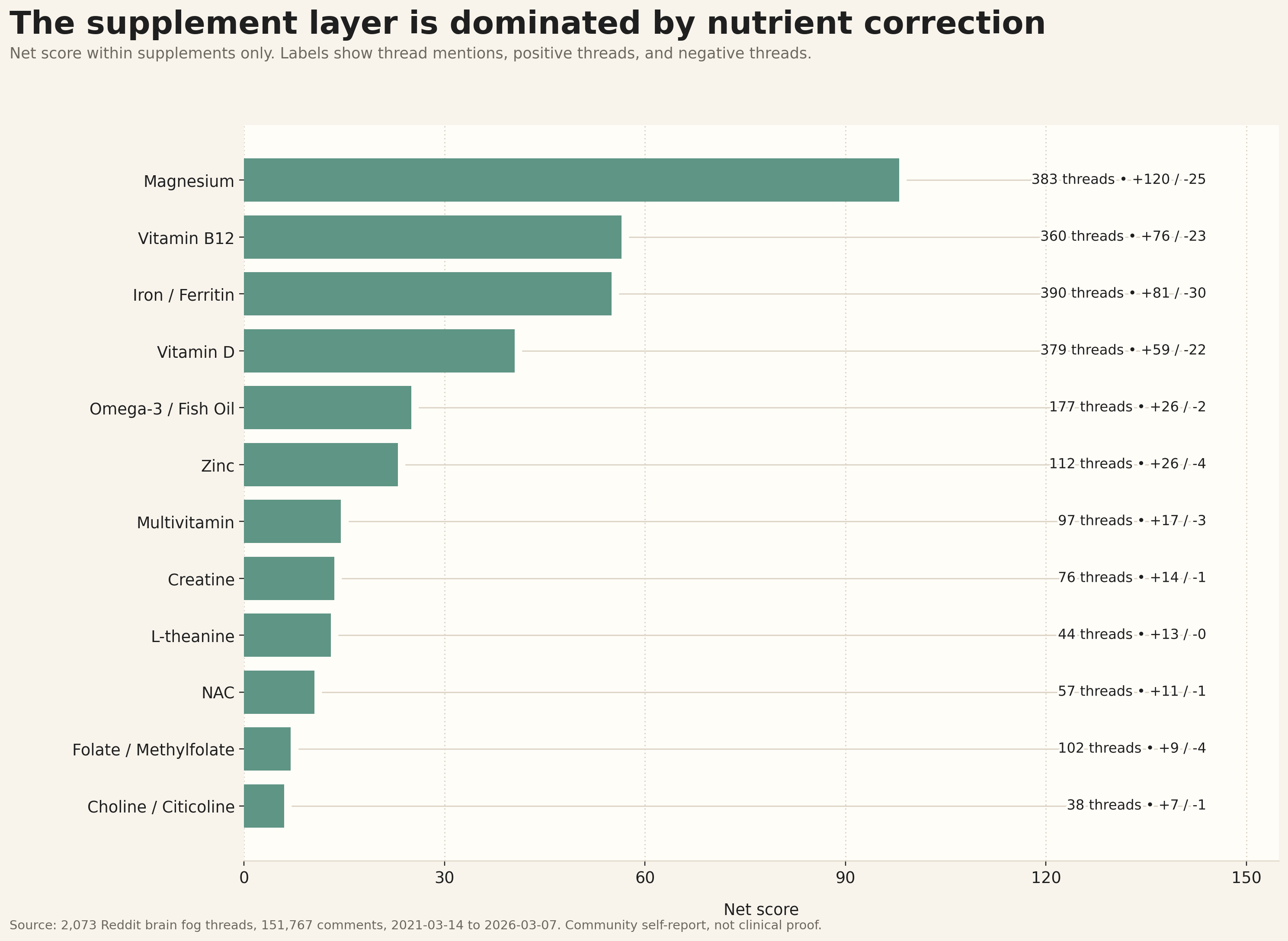
The supplement chart is more conservative than the internet usually is.
The top layer is familiar and surprisingly robust: Magnesium, Vitamin B12, Iron / Ferritin, and Vitamin D. Those are not trendy answers, but they recur again and again. Lower down, Omega-3 / Fish Oil, Zinc, Creatine, L-theanine, NAC, and Choline / Citicoline form a secondary tier.
One interpretation is that the supplement story is not mainly about flashy cognitive enhancers. It is often about correcting basic physiological problems first: deficiency, stress load, sleep quality, energy balance, and inflammation-adjacent issues.
5. Which medications stand out?
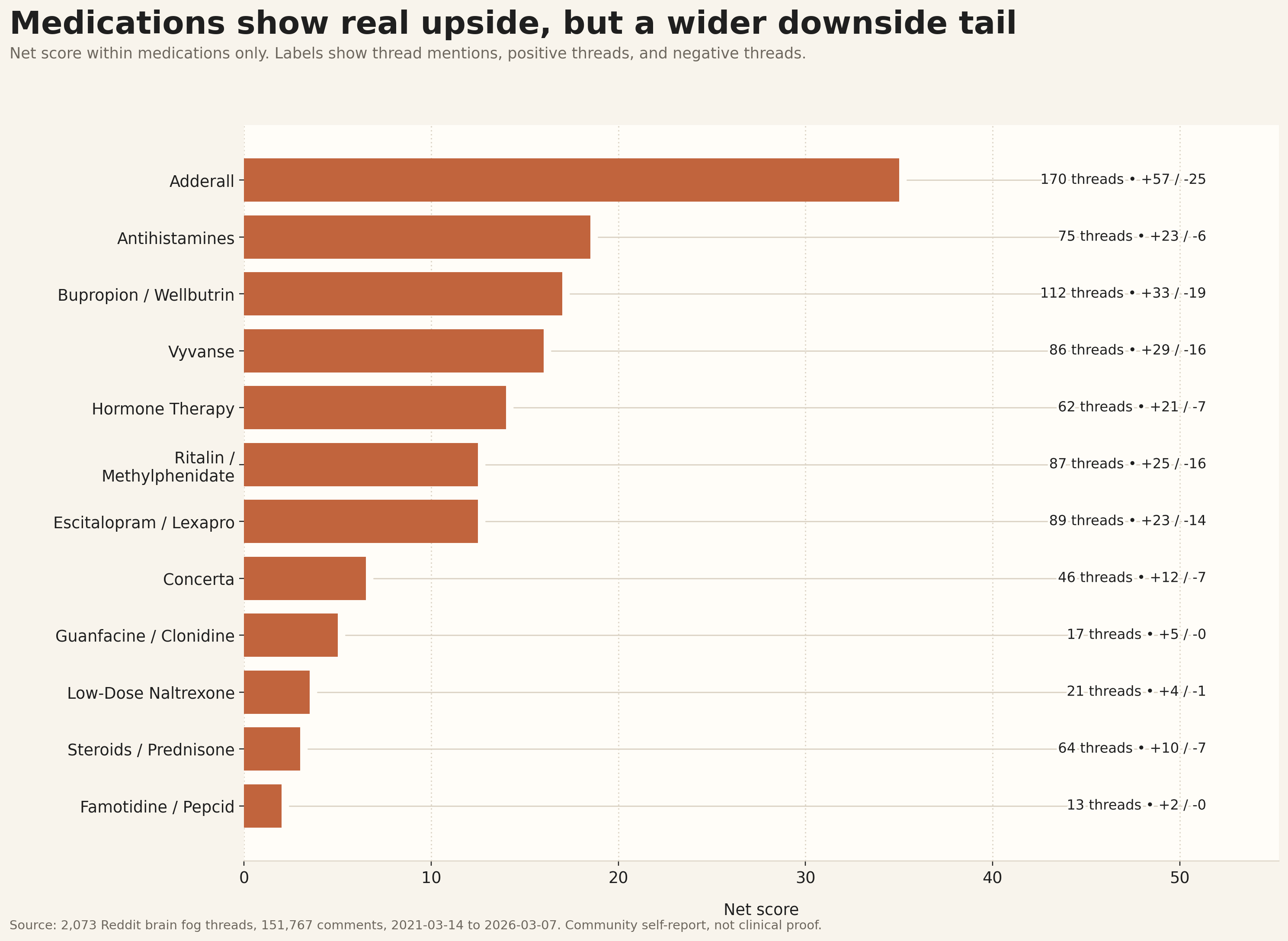
The medication chart has a different feel from the supplement chart.
Adderall leads this category, followed by Antihistamines, Bupropion / Wellbutrin, Vyvanse, Hormone Therapy, Ritalin / Methylphenidate, and Escitalopram / Lexapro. That does not mean all of these are equally good candidates. It means they recur in a large number of threads with enough positive reports to remain visible after penalties.
The deeper point is that medications often track subtypes. Antihistamines appear in histamine, MCAS, allergy, and post-viral contexts. Hormone therapy appears in menopause and deficiency-adjacent contexts. Stimulants appear where the conversation overlaps with ADHD-like cognitive symptoms, executive dysfunction, or mental fatigue.
6. Which protocols rise above the rest?
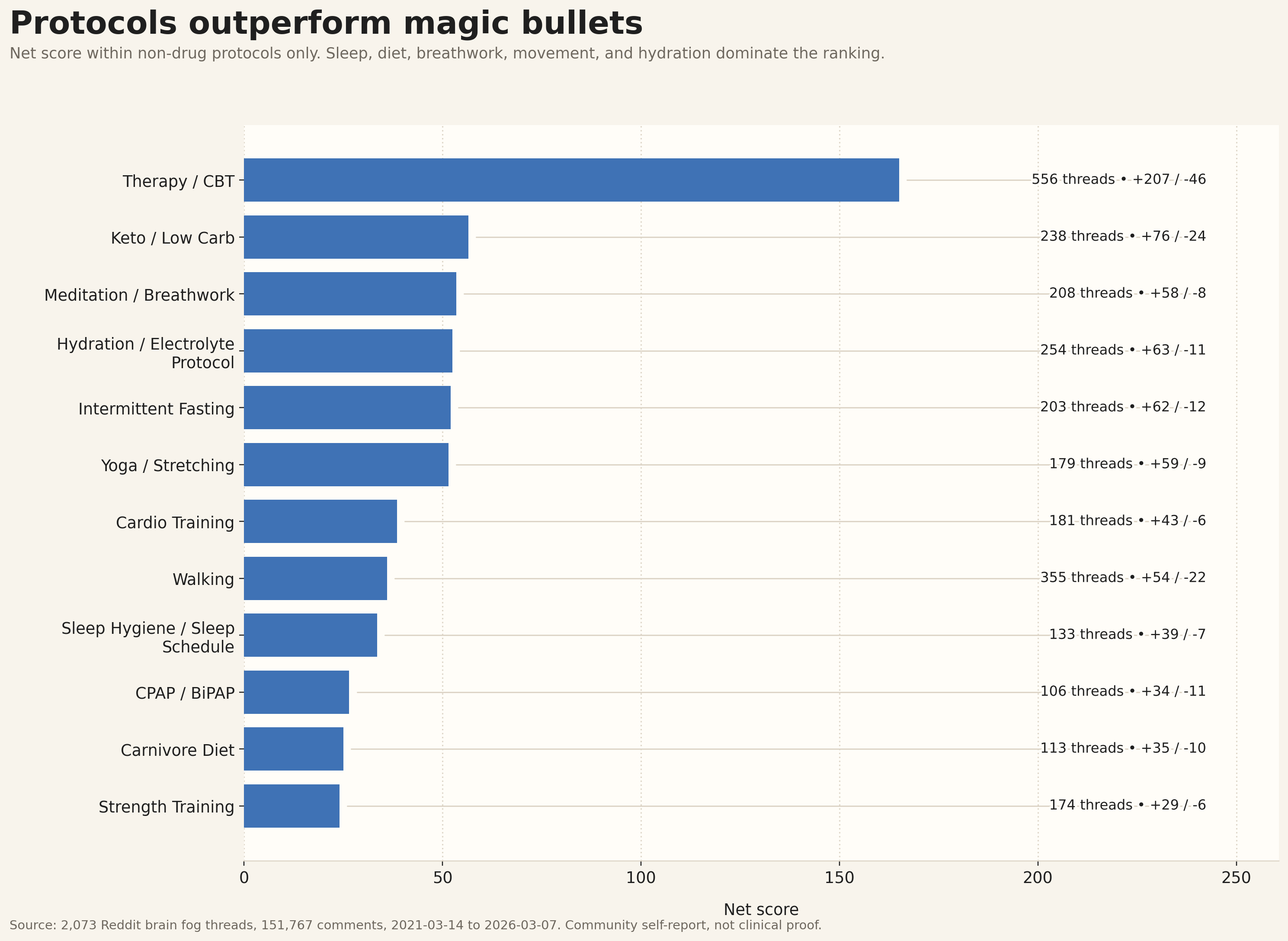
If you zoom out from pills and look at routines, the structure gets clearer.
Therapy / CBT dominates the protocol category. Then come Keto / Low Carb, Meditation / Breathwork, Hydration / Electrolyte Protocol, Intermittent Fasting, Yoga / Stretching, Cardio Training, Walking, Sleep Hygiene / Sleep Schedule, and CPAP / BiPAP.
This is one of the strongest signs that brain fog is often lived as a systems problem rather than a single missing ingredient. People are trying to regulate sleep, stress, blood sugar, breathing, exertion, hydration, and autonomic stability all at once.
7. Which hidden gems punch above their weight?
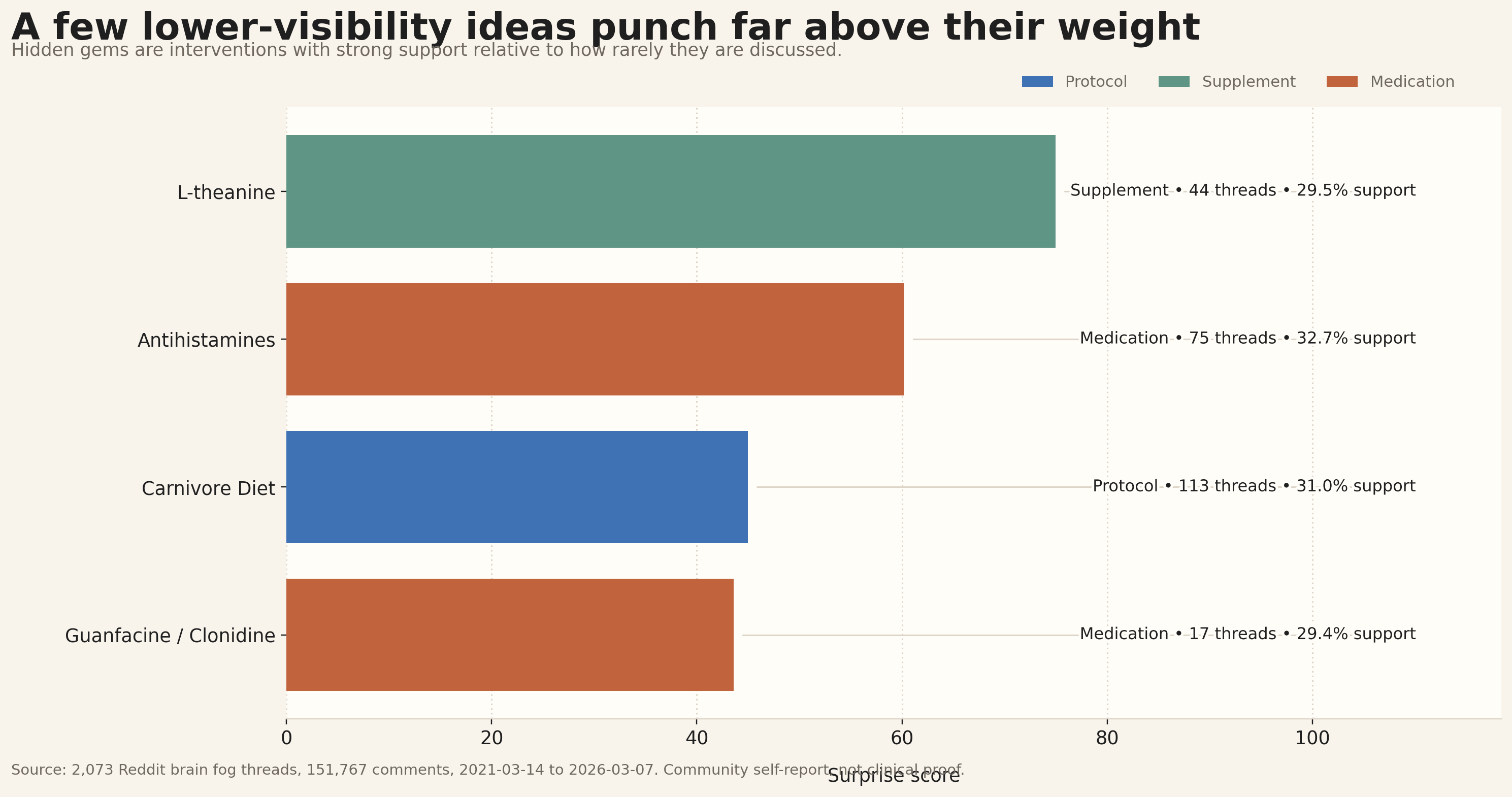
This chart is where the analysis starts to get interesting.
The standout names are L-theanine, Antihistamines, Carnivore Diet, and Guanfacine / Clonidine. These are not the most talked-about ideas overall, but they look stronger than their low visibility would predict.
That makes them worth paying attention to, not because they are proven winners, but because low-visibility signals are exactly where communities sometimes notice something before it becomes mainstream.
8. What looks underrated once you combine signal quality and surprise?
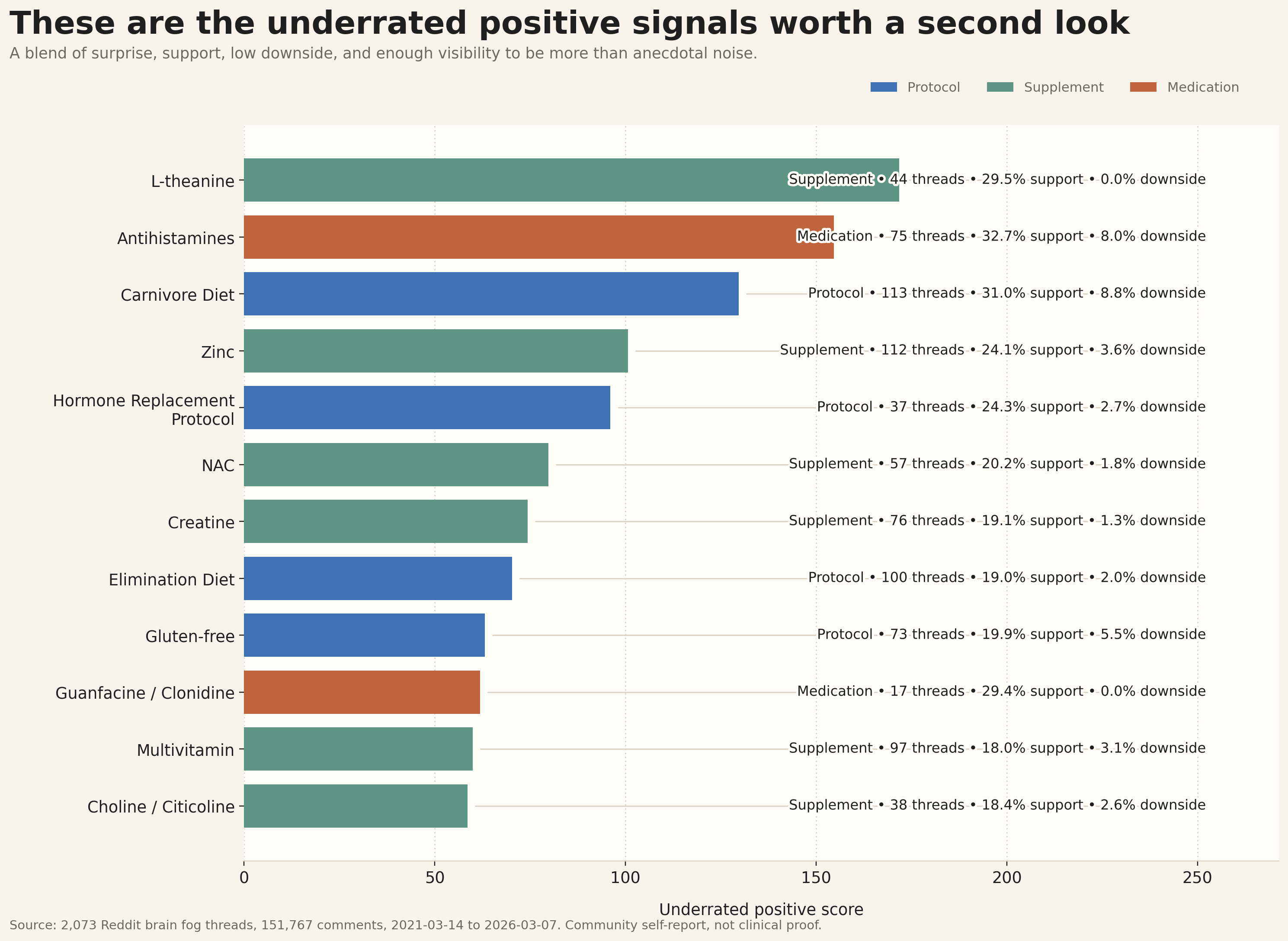
The underrated-positive ranking broadens the hidden-gem idea.
L-theanine remains the strongest low-visibility signal. Antihistamines stay unusually prominent. Carnivore Diet, Zinc, Hormone Replacement Protocol, NAC, Creatine, Elimination Diet, Gluten-free, Guanfacine / Clonidine, Multivitamin, and Choline / Citicoline all show up as interventions that seem better than their low status would suggest.
Even if not every individual signal survives future scrutiny, the pattern is still useful: many of the overlooked signals cluster around inflammation, diet tolerance, autonomic regulation, or deficiency correction rather than generic “brain boosters.”
9. Which very low-visibility ideas still deserve attention?
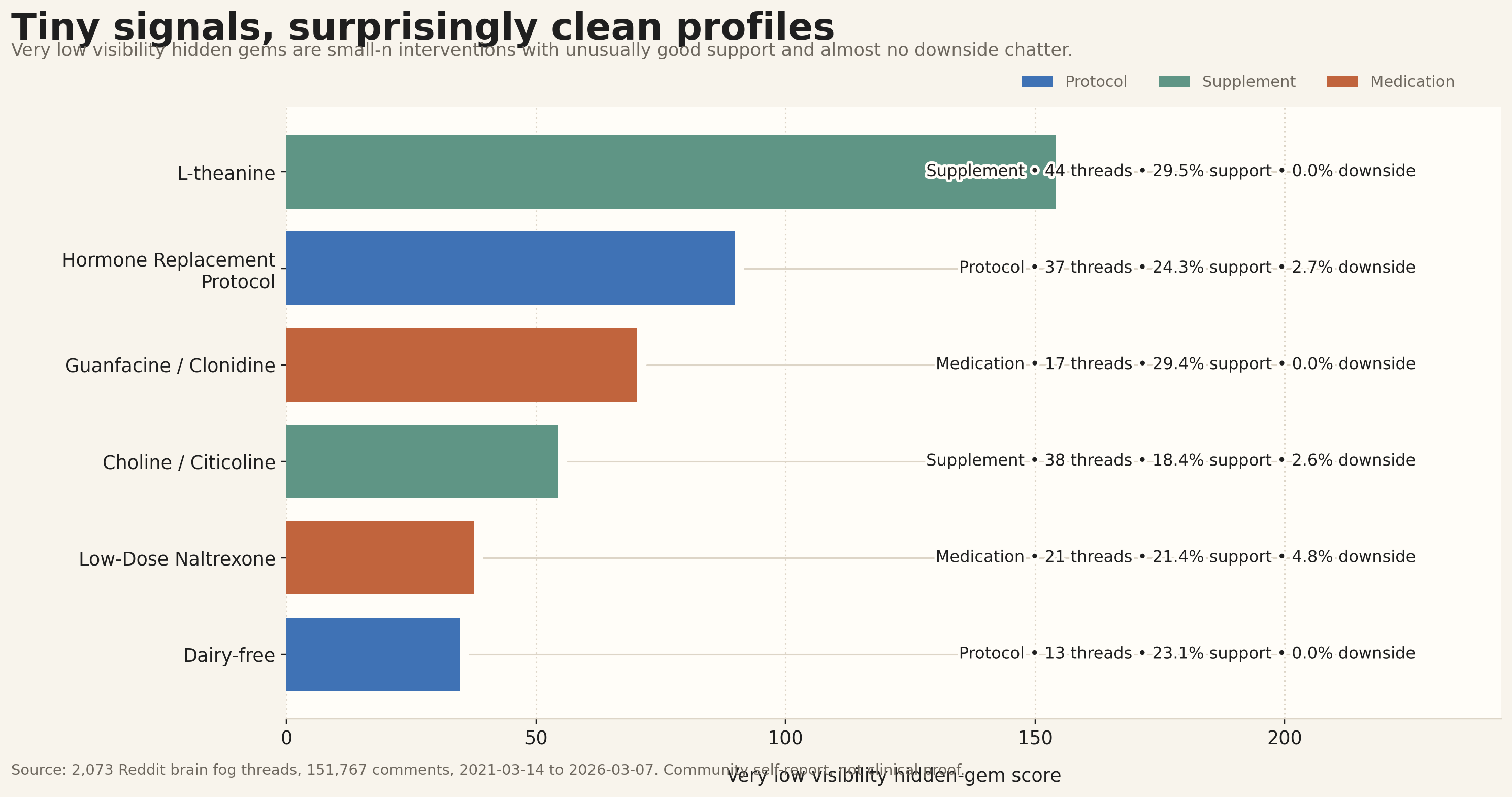
Once the filter becomes more demanding, the list gets narrower and more provocative.
L-theanine still holds up. Hormone Replacement Protocol remains notable. Guanfacine / Clonidine, Choline / Citicoline, Low-Dose Naltrexone, and even Dairy-free appear as small but non-trivial signals.
These are exactly the kinds of findings that can generate useful next questions. Not “this definitely works,” but “why does this show up here, and for which subgroup?”
10. Which interventions look positive with comparatively low downside?
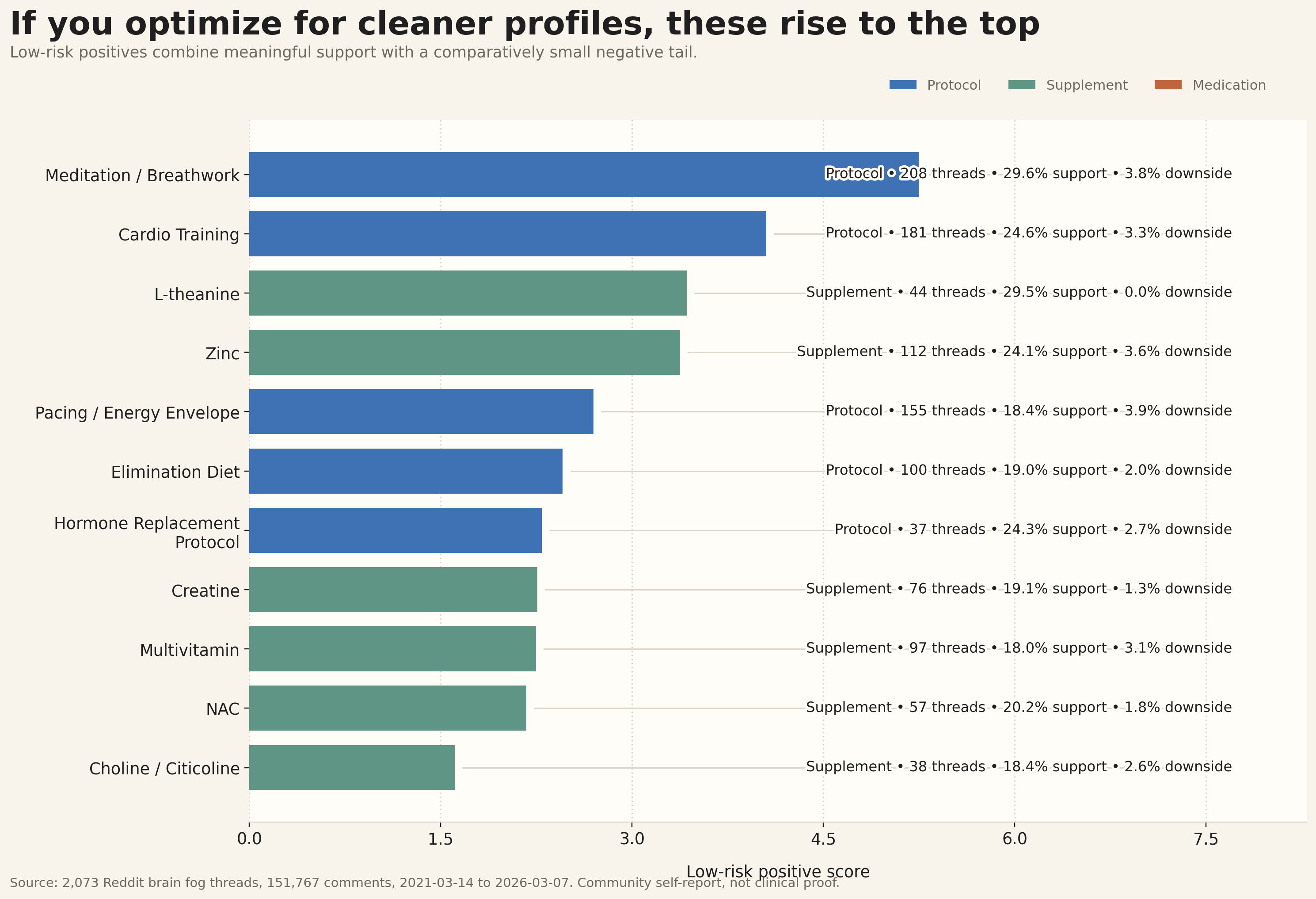
This is one of the most practical charts in the whole set.
If you care about interventions that combine meaningful positive reports with a relatively small negative tail, Meditation / Breathwork, Cardio Training, L-theanine, Zinc, Pacing / Energy Envelope, Elimination Diet, Hormone Replacement Protocol, Creatine, Multivitamin, NAC, and Choline / Citicoline move up.
This is not a prescription list, but it is a very useful triage list. It tells you where the Reddit conversation sees relatively good upside without as much complaint burden.
So what did this project actually change for me?
The biggest shift was not finding a silver bullet. It was losing the expectation that there should be one.
Once you stop looking for the answer to brain fog, the dataset becomes much easier to read. Some interventions dominate attention. Some keep attracting positive reports. Some are clearly polarizing. Some low-visibility ideas look stronger than expected. And the overall conversation is much more structured than it first appears.
That, to me, is the real value of the project.
It does not tell us what is clinically true. It does not tell us which intervention will work for any one person. And it certainly does not settle the biology.
But it does show how people are collectively making sense of brain fog at scale. And that turns out to be surprisingly informative.
If five years of Reddit discussion suggest anything, it is this: brain fog does not look like one uniform problem with one uniform answer. It looks more like a label people use for a cluster of overlapping cognitive and physiological failure modes that can arrive through very different routes.
Not: what is the one cause of brain fog?
Something harder, and probably more useful:
What if brain fog is not one thing at all, but a genuinely multifactorial pattern that different people reach through different combinations of sleep disruption, deficiency, inflammation, hormones, diet, stress, medication effects, autonomic dysfunction, and post-exertional collapse?